
“2001: A Space Odyssey” and the Monolith

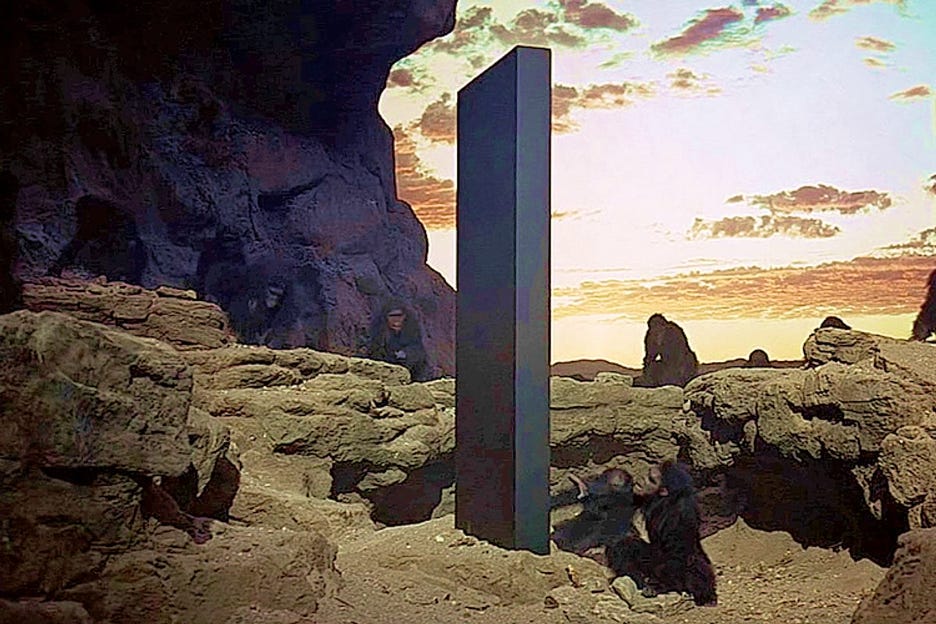
2001: A Space Odyssey
1968. Director: Stanley Kubrick
Starring: Keir Dullea, Gary Lockwood
“2001: A Space Odyssey” (1968) opens to the majestic strains of Richard Strauss’s “Also sprach Zarathustra.” Soon, viewers are confronted with a barren landscape where gusty winds blow. Apes appear on the terrain and some are driven from a waterhole by others. The exiles—apparently a small clan—awaken one morning to a strange sight: a dark, rectangular monolith. The object conflicts shockingly with its primeval surroundings. What can it be? As they encounter it, the apes go. . . let’s face it, they “go ape.”1
The creatures’ discovery of the monolith is perturbing. They become alarmed by its presence in their midst. They sense that something is wrong and, by extension, so does the audience. The silence of this realm is broken by the shrieks and cries of the apes. Suddenly, as eerie vocals are heard, some of the beasts timidly reach out to touch it, fearful of what might happen. The voices rise to a feverish, ominous pitch and the sun rises over the monolith. The scene ends abruptly.
Kubrick’s monolith is enigmatic. What does it represent? Why does it cause havoc among the creatures? Is it supernatural? Is it sentient? The film offers no clarification. Kubrick preferred not to explain any of the movie, leaving viewers to figure it out for themselves.2
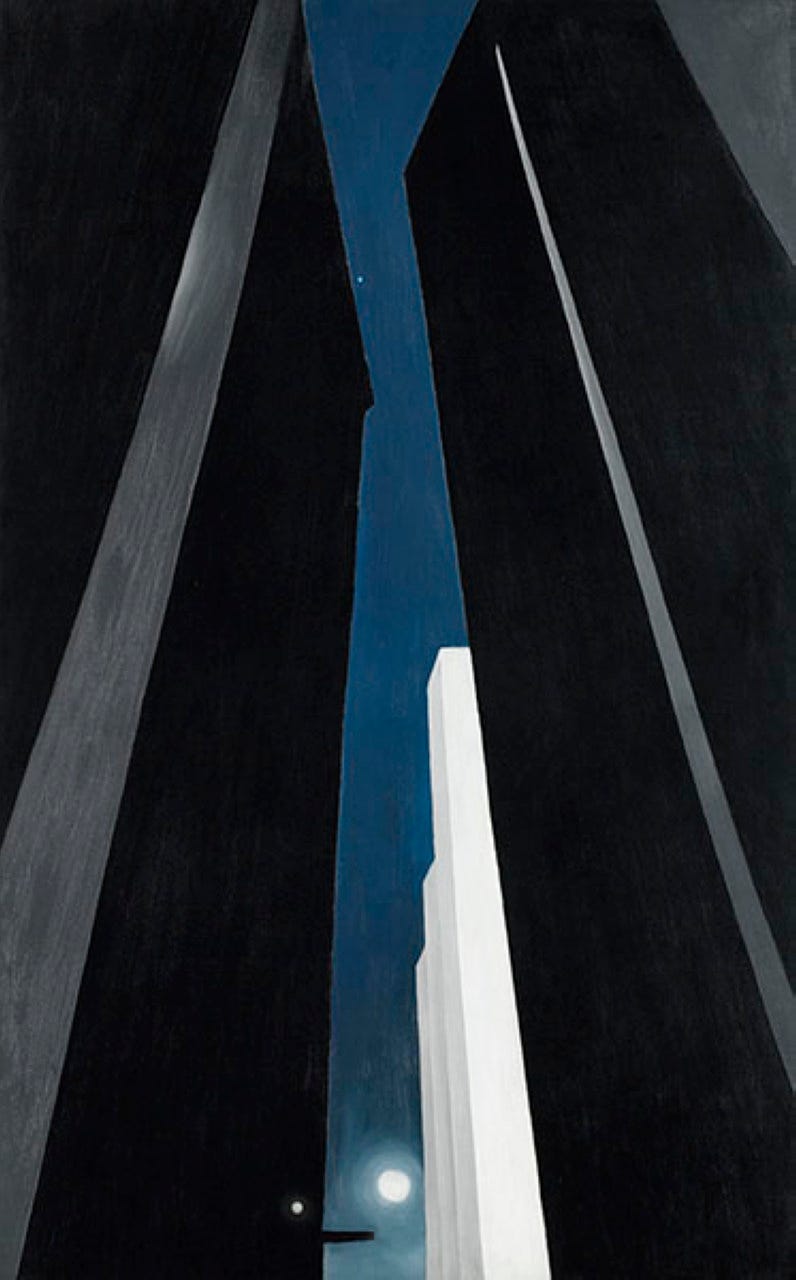
Kubrick wanted audiences to interpret his film any way they chose. His refusal to decipher the movie reflects the tendency of modern artists to avoid decoding their work.3 Kubrick mirrors the midcentury rebellion, in which artists consistently broke from tradition, creating increasingly enigmatic imagery without demystifying it. More importantly, his monolith is strongly influenced by modern art and architecture. Consider Georgia O’Keefe’s City Night from 1926. The painter depicts two dark, looming skyscrapers at night in a veering perspective. In spite of its modest size, the massiveness of its structures overwhelms the image. As is the case with Kubrick’s monolith, they demonstrate a precise linearity and their presence dwarfs us, almost ominously.
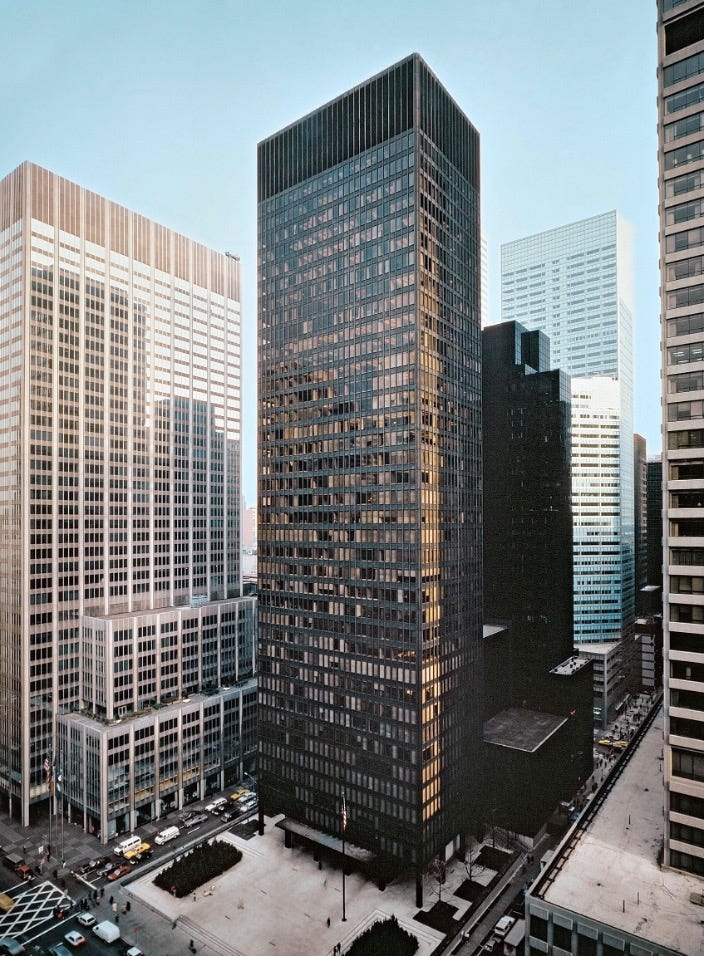
Similarly, the Seagram Building in New York City, completed ten years before Kubrick’s movie, towers over pedestrians and vehicles below it. Built in the International Style, it became symbolic of a worldwide modernist aesthetic at midcentury. As with comparable skyscrapers, it employs a strict geometry, a polished simplicity, and a sense of anonymity and elegance, while abandoning traditional aesthetic norms.4 It also stands silently and authoritatively, as does Kubrick’s structure.
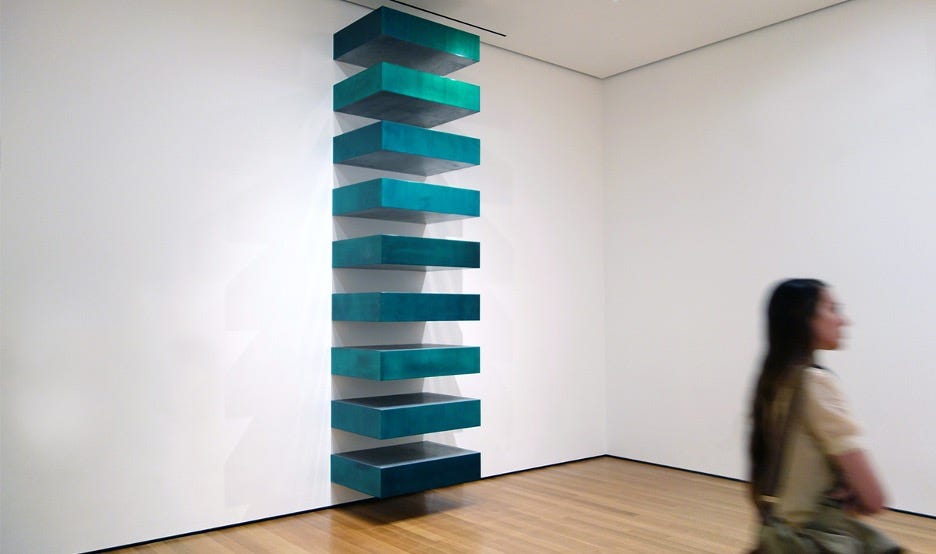
We might even compare Kubrick’s monolith with Minimalist Art, such as Donald Judd’s sculptures. Minimalism strips away non-essentials in art, avoiding any resemblance to nature or objectivity and eliminating emotion and symbolism from the creation.5 Judd’s Untitled (Stack), 1967, even lacks a title that could help offer an interpretation or link it to an object or an idea. Thus, the sculpture is freed from any traditional reference point, other than color, line, geometry, and a machine aesthetic. Judd’s sculpture is an exact contemporary of Kubrick’s film.
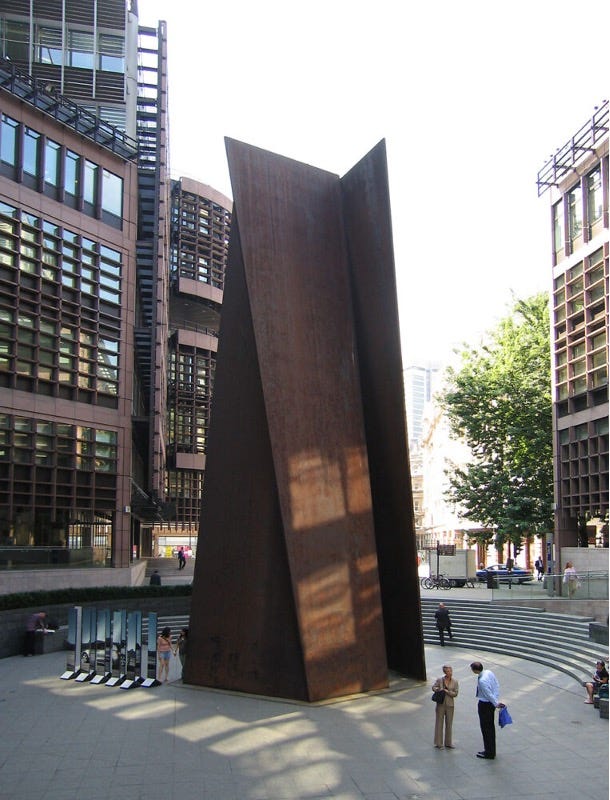
I am tempted to consider the works of Richard Serra in reference to Kubrick’s monolith. The raw severity of Serra’s sculptures, such as Fulcrum (1987), made from rusted and forged steel become aloof, inscrutable, dominant entities.6 They are often site-specific creations that refuse to blend into their environments, as is the case with Kubrick’s structure. Serra’s oeuvre falls under the category of Postminimalism, which emerged from Minimalism but focuses on the viewer’s experience, site-specificity, and simple materials—specifically rejecting the perfect machine-made aesthetic of Minimalism.7 Many of Serra’s works, however, postdate Kubrick’s film, and in some cases, might question if the film influenced Serra.8
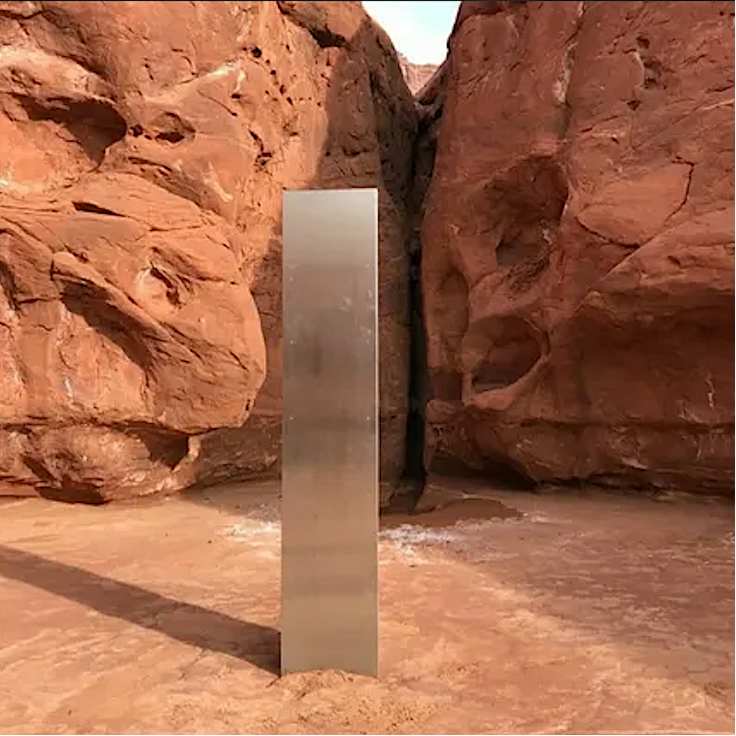
One might take the idea of influences a step further and ponder Kubrick’s impact on later generations. The year 2020 can be considered one of the most tumultuous in recent history for a variety of reasons: a pandemic and quarantine, social protests, an economic recession, etc.9 An odd occurrence on November 18, 2020, was the discovery of a monolith in a remote Utah desert. State biologists spotted the object during a helicopter survey of local wildlife. The monolith made headlines and, of course, it was compared to Kubrick’s. Some even wondered if it was placed there by extraterrestrials. Soon thereafter, it was mysteriously removed.10 Its purpose, meaning and creator remain a puzzle to date. Its shape, material and placement in a canyon recall the one in the film. Its unexplained presence there also suggests eerie similarities.
Personally, I was never really interested in finding out who (or what, if you like) placed the object in Utah. It would have been disappointing to discover that Joe Schmoe and his pals set it up. The mystery was its magic because it sparked everyone’s imagination. By extension, the same is true of Kubrick’s monolith. What does it mean to the apes? What does it symbolize to us? These don’t matter either. Its apparition before the apes (and viewers), its ineffability, its evocativeness, its portentousness, are its meaning. The feeling it creates in the spectator—that’s its importance.
Copyright © 2026 by Rosi Prieto, Ph.D.
All Rights Reserved
[1] The introductory segment of the film can be seen here:
The term “monolith” implies a single object made of stone; I use it here for the sake of consistency with the writings of others, and lack of a better term. See: https://en.wikipedia.org/wiki/2001:_A_Space_Odyssey
See, for example, the work of Jackson Pollock: https://en.wikipedia.org/wiki/Jackson_Pollock
See also: https://www.britannica.com/art/art-criticism/Art-criticism-in-the-20th-century
In particular, I’m thinking of sculptures such as the ones in Qatar (East-West/West East) and the Gagosian installations in New York (Every Which Way): https://www.rmoutlook.com/national-sports/richard-serras-art-installation-hard-to-miss-in-qatar-desert-once-you-get-there-6199762
https://www.wallpaper.com/art/richard-serra-weighty-installation-at-gagosian-gallery-new-york
[1]Other “copycat” monoliths soon appeared in various cities. https://www.fox5ny.com/news/mysterious-monolith-found-in-remote-part-of-utah
https://en.wikipedia.org/wiki/Utah_monolith
https://pasoroblespress.com/aliens-off-the-hook-the-story-behind-the-monolith