
I’ll Never Get Over Macho Grande

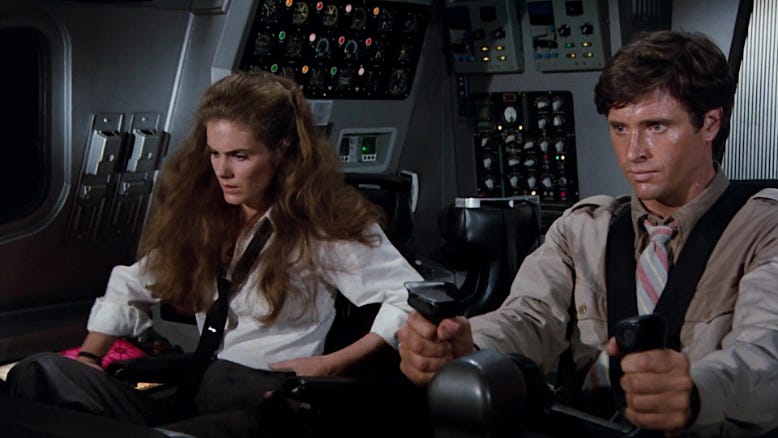
Airplane II: The Sequel
1982 Director: Ken Finkleman
Starring: Robert Hayes, Julie Haggerty, Lloyd Bridges, Chad Everett, Peter Graves
“Airplane II” is perhaps even more ludicrous than its predecessor. In this comedy, set sometime in the future, approval for a commercial lunar shuttle is rushed for its maiden voyage to the colonized moon. Lacking government approval because the shuttle failed to meet safety requirements, its directorial board conceals this information from the public so as to keep its launch on schedule.
Another problem is that when Ted Striker (Hayes) crashed a test flight for the mission, he suffered a mental breakdown and was institutionalized at the Ronald Reagan Hospital for the Mentally Ill.1 Striker warned the board that the shuttle was unsafe. His warnings not only went unheeded but were also buried. When he finds out about its impending flight, he escapes the institution, determined to save the passengers, including his former love, Elaine Dickinson (Haggerty), who is the shuttle’s computer officer. Compounding Striker’s credibility issue is the sham trial he received after losing his squadron over “Macho Grande” during the war and suffering from post-traumatic stress disorder: he was blamed for everything. This comedy was less than well-received by critics. This is unfortunate, I believe, because of the film’s pointed message: authority figures sometimes hide the truth in order to fulfill their agenda.
An example of this is evident in the movie’s dialog, particularly in the double-speak throughout, such as during Striker’s trial. In one scene, a prosecutor (John Larch) interrogates a witness (Louis Giambalvo) about Striker’s “incompetency” over Macho Grande. The confusion it causes is actually hilarious, but it speaks of twisting people’s words in an official setting.
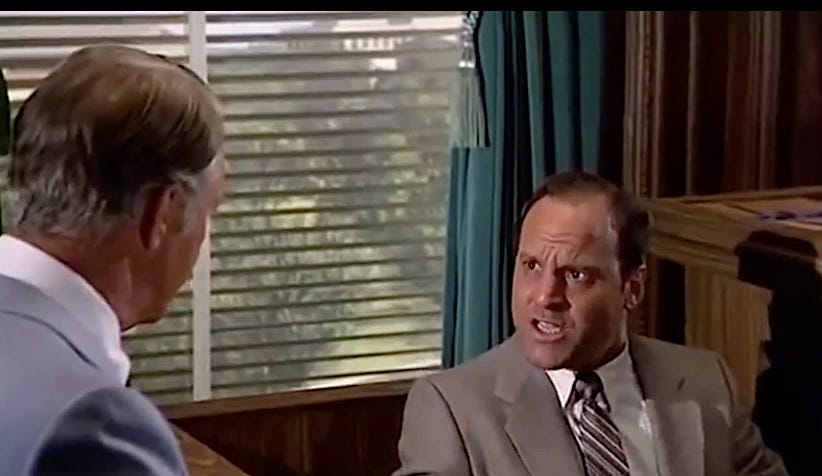
Witness: I flew with Striker during the war. I’ll never forget the night we bombed Macho Grande. Striker was the squadron leader. He brought us in real low. But he couldn’t handle it.
Prosecutor: Buddy couldn’t handle it. Was Buddy one of your crew?
Witness: Right. Buddy was the bombardier. But it was Striker who couldn’t handle it. And he went to pieces.
Prosecutor: Andy went to pieces?
Witness: No! Andy was the navigator. He was alright. Buddy went to pieces. It was awful, how he came unglued!
Prosecutor: Howie came unglued?
Witness: Oh, no! Howie was a rock, the best tail-gunner in the outfit! Buddy came unglued!
Prosecutor: And he bailed out?
Witness: No! Andy hung tough! Buddy bailed out. How we survived was a miracle.
Prosecutor: Then Howie survived?
Witness: No. Afraid not. We lost Howie the next day.
Prosecutor: Over Macho Grande?
Witness: No. I don’t think I’ll ever get over Macho Grande. Those wounds run pretty deep.2
Clearly, whatever happened at Macho Grande was terrible. And Commander Buck Murdock (William Shatner), who flew with Striker on that mission, also harbors ill will towards him. Murdock, who now commands the Alpha Beta Lunar Base, agrees to help him land the shuttle when its computer malfunctions. I appreciate Shatner’s appearance in the film. His legacy as Captain Kirk in the original “Star Trek” series makes him symbolic of space travel in general and of being a good decision-maker under fire. Here, he pokes fun at himself and his legacy. The confusing double-speak is present here, too.
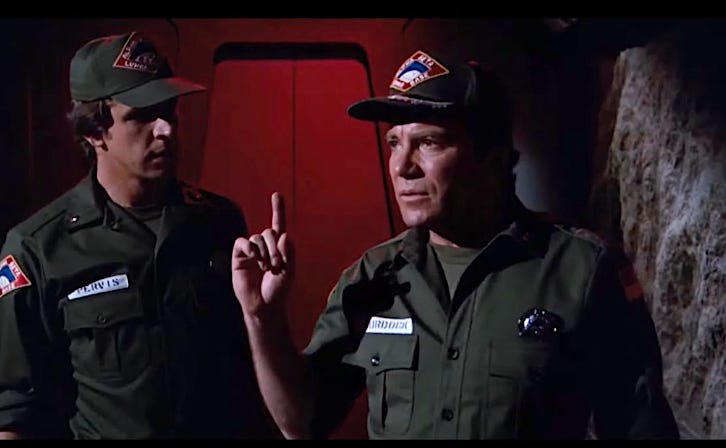
Comdr. Murdock: Who’s in control of that bucket, Lieutenant?
Lt. Pervis: A guy by the name of Ted Striker, Sir.
Comdr. Murdock: Ted Striker. . . .
Lt. Pervis: Do you know him, Sir?
Comdr. Murdock: Never heard of him. That’s not exactly true. We were like brothers. We flew together during the war. We were close; we were close.
Lt. Pervis: Until, Sir?
Comdr. Murdock: Until that day over Macho Grande.
Lt. Pervis: Over Macho Grande, Sir?
Comdr. Murdock: I’m afraid I’ll never get over Macho Grande.3
Rosi: I won’t either.
Copyright © 2026 by Rosi Prieto, Ph.D.
All Rights Reserved
This joke critiques the unfortunate closing of mental health institutions by the Reagan Administration in 1981: https://en.wikipedia.org/wiki/Mental_Health_Systems_Act_of_1980.
A film clip for this scene can be found here:
Film clip:
.