
The Garage in “Ferris Bueller’s Day Off”
In celebration of the film’s 40th anniversary

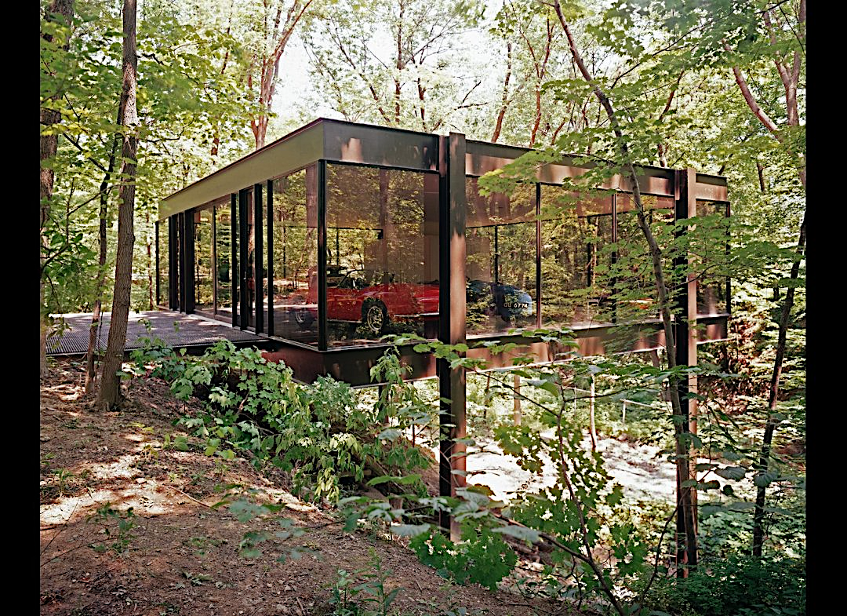
Ferris Bueller’s Day Off
1986. Director: John Hughes
Starring: Matthew Broderick, Mia Sara, Alan Ruck, Jeffrey Jones
“How can I possibly be expected to handle school on a day like this?,” Ferris wonders as he contemplates the sunny morning outside his window. As the cult classic, “Ferris Bueller’s Day Off” begins, the end of the school year approaches in a Chicago suburb, and Ferris is considering cutting class again; he has already done it many times this semester. He tells his parents that he feels sick and will stay home in bed. They believe him.
Ferris asks his best friend, Cameron Frye (Ruck), and his girlfriend, Sloan Peterson (Sara), to join him. He wants Cameron to borrow his father’s 1961 Ferrari 250GT California Spyder for the day. Cameron, a shy hypochondriac, fears his father’s possible reaction and refuses, but Ferris won’t take no for an answer. The trick will be avoiding being caught. Their adventure includes a visit to the Chicago Art Institute, a Cubs game at Wrigley Field, lunch at a swanky restaurant (where Ferris’s father is entertaining clients), and even participation in a parade. Unfortunately, after they park the car downtown, two sleazy garage attendants take the Ferrari for a long joyride. Once Cameron notices the added mileage to the car, he knows he’s in trouble.
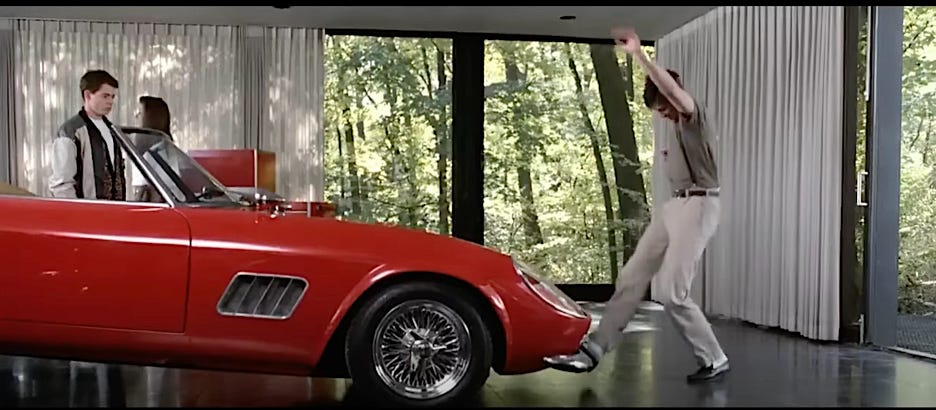
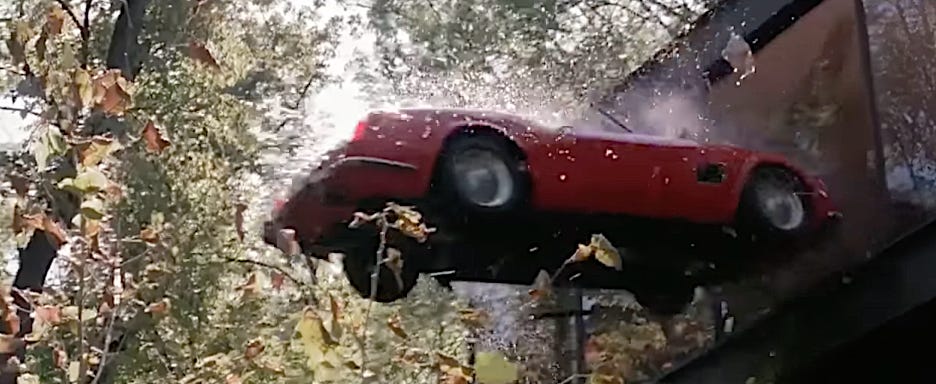
Once back in the Frye garage, Cameron tries to remove the additional mileage by jacking up the rear wheels and running the engine in reverse. It doesn't work. The odometer cannot be turned back. Cameron becomes frustrated and angry by this realization. He vents to his friends: his father cares more about the car than about him. And this leads him to kick the Ferrari’s front end and fender. The repeated kicks eventually dislodge the jack; when it gives way, the car speeds off in reverse, shattering the glass wall in the garage and plunging into the ravine in back.1 The three teens are stunned. There's no way to explain away this situation, much less, to avoid suffering the consequences.
Now, let’s back up for a minute to consider the following: the Ferrari—and the garage itself—are delicate beauties. Their elegance and uniqueness represent Mr. Frye’s success, a man we never encounter. The Frye garage serves to display and protect his treasures. The structure is a container, a showcase, a museum for Frye’s prized possessions and a symbol of his wealth and worth. Its strict geometry in a serene, wooded area signals Frye’s dominance, his control of everything (and everyone) around him.
Actually, the garage in the film is part of the Ben Rose House in Highland Park, in the Chicago outskirts. The property was built by A. James Speyer, a student of the prodigious Ludwig Mies van der Rohe in 1953 for Ben Rose, a textile artist, and his wife, Francis. The garage was added in 1974 by David Haid to display the Roses’ collection of sports cars.2 The garage is a stainless-steel-and-glass structure on pylons over a ravine. So basically, it's a cube on stilts. But it boasts an enviable pedigree: Le Corbusier’s Villa Savoye (1928-31), Frank Lloyd Wright’s “Fallingwater” (1935-39), and Philip Johnson’s Glass House (1948-49). The garage shares certain features with all three of its precedents, which are some of the most important examples of modernist domestic architecture. Modernist construction conceived clean structures with simple, elegant lines, free from conventions and historical precedents. It also created a marriage between art and industrial design, borrowing elements from both and incorporating them into the domestic sphere.3
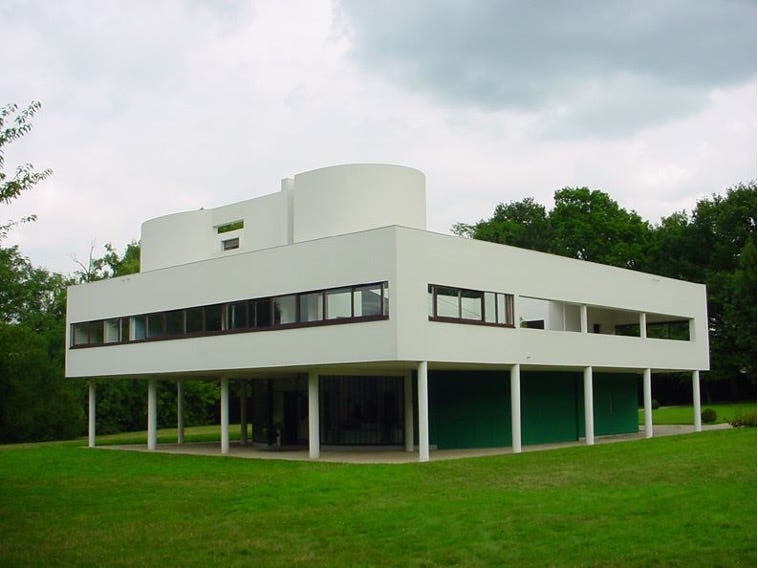
The Villa Savoye near Paris was one of the earliest homes to adopt modernist elements in its design. The structure, created as a weekend retreat, is essentially a shallow cube with slit-like windows upon steel posts. Its simplicity and smoothness reflect its origin in machine-made elements, a novelty at the time. Its buoyancy and white coloring suggest its ability to transcend and dominate its surroundings, refusing to succumb to the landscape, and elevating human construction above nature’s whim. The greenery is subordinate.4
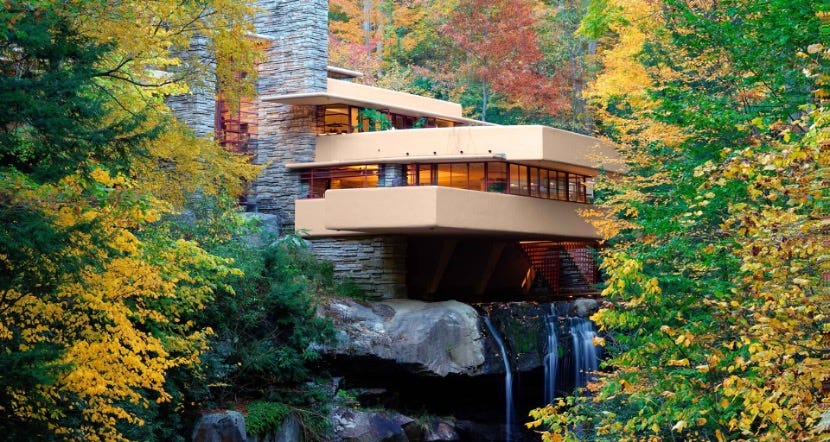
“Fallingwater” was also conceived as a weekend getaway, this time for a Pittsburgh capitalist. Wright’s masterpiece floats effortlessly above a waterfall, with its primary living spaces cantilevered daringly over it. The cantilevers eliminated the need for load-bearing walls, which are replaced by glass that allow a near 360-degree view of its surrounding forest.5
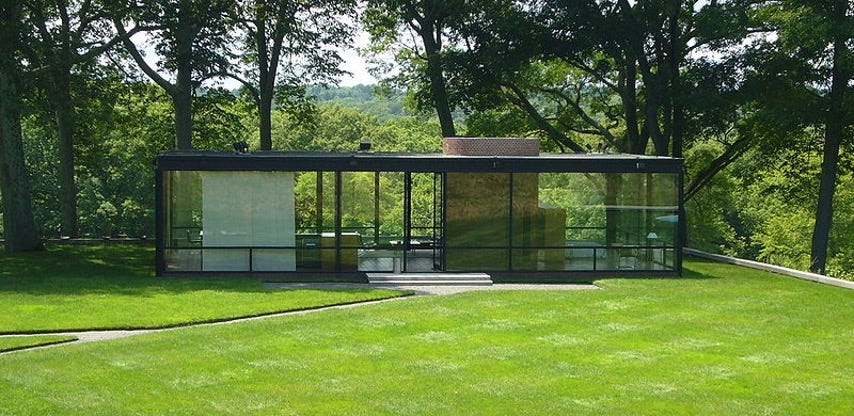
Johnson’s Glass House is the closest cousin to the Frye garage. It is a Minimalist glass-and-steel structure that does away with walls altogether. Johnson (who lived there for a time with his companion, David Whitney) once said that its surrounding landscape is its “wallpaper.” Its kitchen, living, and sleeping areas share the flowing open space. A brick floor-to-ceiling cylinder at its core contains the bathroom and dressing areas for privacy.6
These three homes created a watershed in early 20th century domestic architecture. Their simplicity and elegance signaled a divorce from the past. Their presence in bucolic environments creates an interesting tension, particularly in their use of glass. This element pretends to allow nature inside the structures while hermetically sealing it off. Their pastoral settings also helps to soften their harsh lines. Several decades after their emergence we see their progeny in the Frye garage.
The appearance of this elegant garage in “Ferris Bueller’s Day Off” made it famous. And its (simulated) destruction (along with the Ferrari) is a necessary a plot point, creating a dramatic pinnacle in the story line. The teens had lots of fun on their day off and we can’t expect them—especially Cameron—to get away without circumstances. Moreover, the viewer wants destruction—it’s schadenfreude. We want to take the event to its ultimate conclusion and delight in someone else’s misfortune. Clearly, Mr. Frye is a bastard for what he has done psychologically to Cameron, who is afraid of his own shadow; hopefully, Cameron will no longer fear his father after this event. It seems fitting that both the car and the garage should be destroyed in one fell swoop. And this is best encapsulated in the initial discussion Ferris and Cameron have about borrowing the car:
Cameron: The 1961 Ferrari 250GT California. Less than a hundred were made. My father spent three years restoring this car. It is his love, it is his passion. . .
Ferris: It is his fault he didn’t lock the garage.
Serves Frye right.
Copyright © 2026 by Rosi Prieto, Ph.D.
All Rights Reserved
A clip of this scene is found here:
https://en.wikipedia.org/wiki/Modern_architecture
https://fallingwater.org
https://theglasshouse.org
https://en.wikipedia.org/wiki/Glass_House_(New_Canaan,_Connecticut)