
The "Mouth of Truth" and a Few Lies

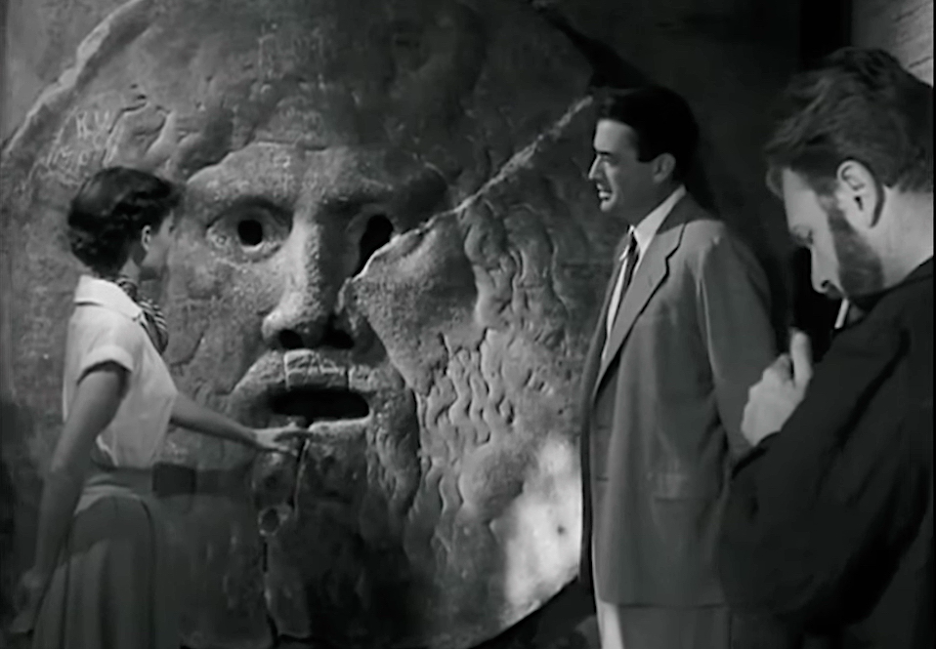
In 1953, “Roman Holiday,” featuring Gregory Peck and Audrey Hepburn (in her first starring role), made headlines. In this charming comedy-romance, Crown Princess Ann (Hepburn) is on a state visit to Rome. In spite of her lofty title, she holds no power. She is a mere figurehead traveling for public relations with tight schedules and no autonomy.1
No one lets Princess Ann have any fun; it’s all too much work for the adolescent and she becomes very agitated that evening. After her doctor administers a sedative, she escapes the embassy to explore the city. She lies sleepily on a bench that night, as Joe Bradley (Peck), an American reporter, sees her and believes she is drunk. He fails to recognize her but feels sorry for her and takes her to his apartment to sleep it off.
Joe seems a constant liar. As a reporter, he was supposed to cover Ann’s visit but he overslept the next day. He arrives at work and tells his boss that he was there, unaware that the interview was cancelled because she is missing. Seeing her picture in the paper, he suddenly realizes this celebrity is back at his apartment. Joe takes advantage of his luck: he figures he can get an exclusive interview by giving her the city tour she wanted—and asks his photographer friend, Irving (Albert), to take pictures of her secretly with his lighter/camera.
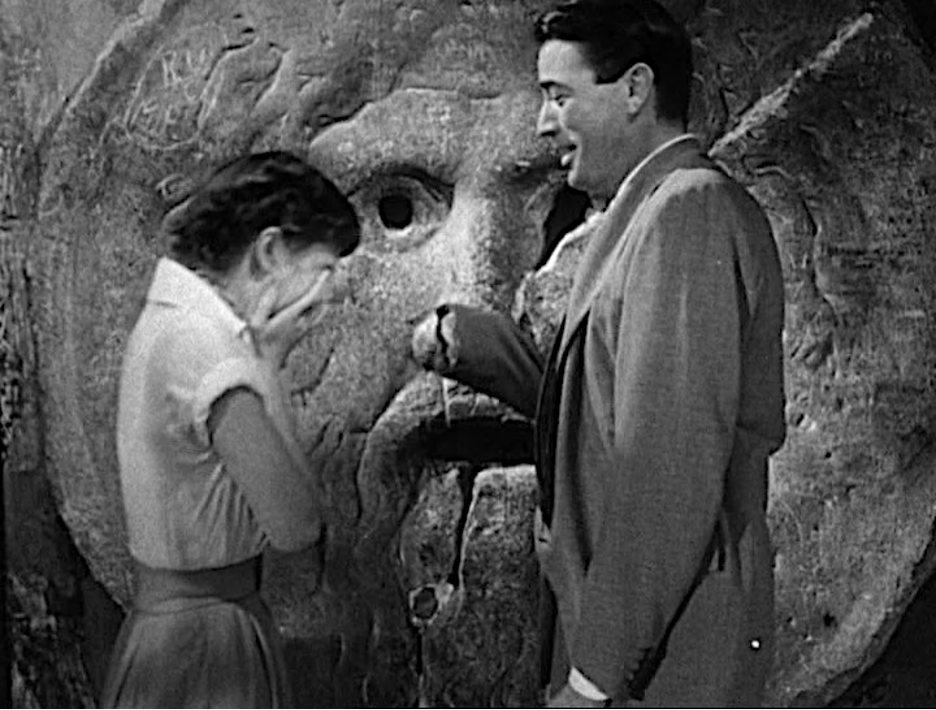
On the tour, Joe takes Ann to the Church of S. Maria in Cosmedin’s portal, where the ancient Roman sculpture known as La Bocca della Verità (The Mouth of Truth), is located. He tells a naïve Ann: “The Mouth of Truth: legend is that if you give it a lie and put your hand in there, it will be bitten off.” He asks her to try it and she does so, hesitantly. She then tells him to do the same. In this famous scene, Joe puts his hand in then pretends it’s been bitten off by hiding it in his sleeve. Ann is initially horrified, unaware he is playing a trick on her.2
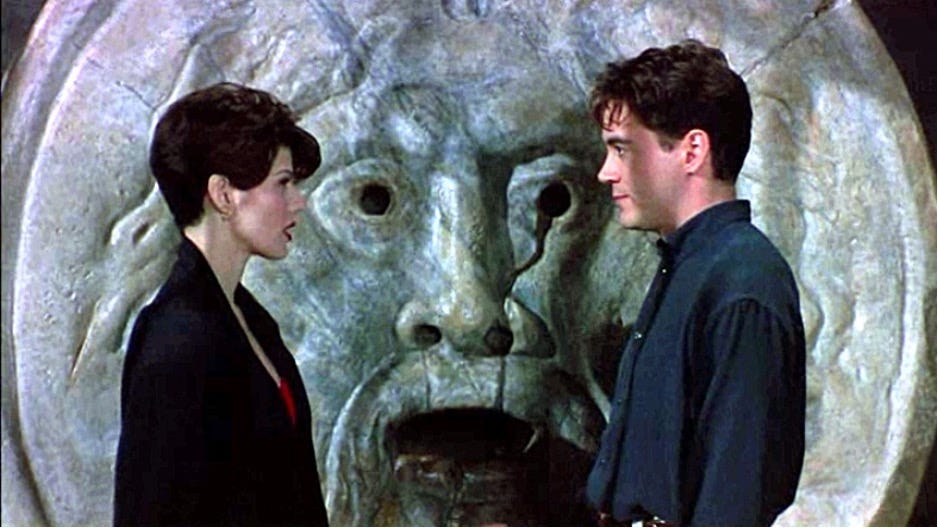
The rom-com “Only You” (1994) contains a scene based on “Roman Holiday.” As a child, Faith Corvatch (Tomei), plays on an Ouija board with her brother, who tells her that a certain Damon Bradley is her destiny. In time, a bribed fortune teller “confirms” this lie for Faith (who is aptly named in the film for her blind trust and belief in what she has been told). She grows to adulthood and—although engaged—travels to Rome to find this man. While there, she stumbles upon Peter Wright (Downey), who falls instantly in love with her and tells her many untruths, including that he is Damon Bradley, to win her over. Peter is even more of a liar than Joe.3
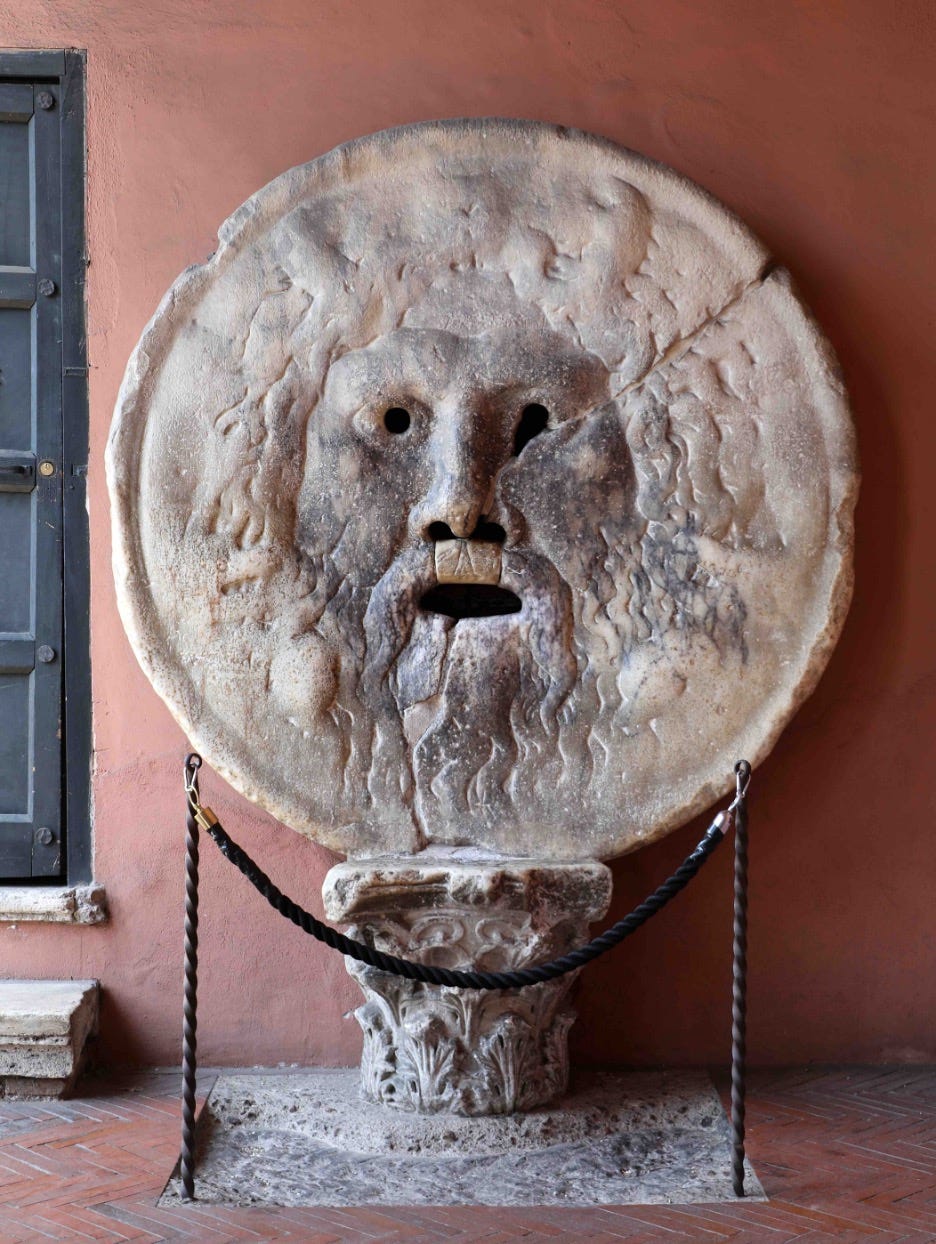
These two films merit some scrutiny, particularly in regards to the scenes with the enigmatic sculpture and the issue of dishonesty. The Bocca della Verità depicts a shaggy, bearded visage and represents the titan god Oceanus (Ocean). It is carved from Phrygian marble, the most coveted luxury stone of the early Roman Empire. In antiquity, this work served as a large drain cover, most likely on the floor of a round temple with an oculus (circular opening) on its dome, dissipating any rainfall and returning it to the sea. Its exact original location, however, is elusive. As noted above, today it is found at the portico of the Church of S. Maria in Cosmedin and, since at least the year 1120, it leaned against this building’s façade.4
The enormous face of the Bocca has gaping eyes and lips. Its expression is ominous, as if the god—in a trance-like state—is about to speak, divulging some terrible truth or prediction. Its original location was likely near the Ara Maxima in the Forum Boarium (the Great Altar in the ancient cattle market) in Rome, where oaths were taken and agreements were made by those wishing to transact business.5
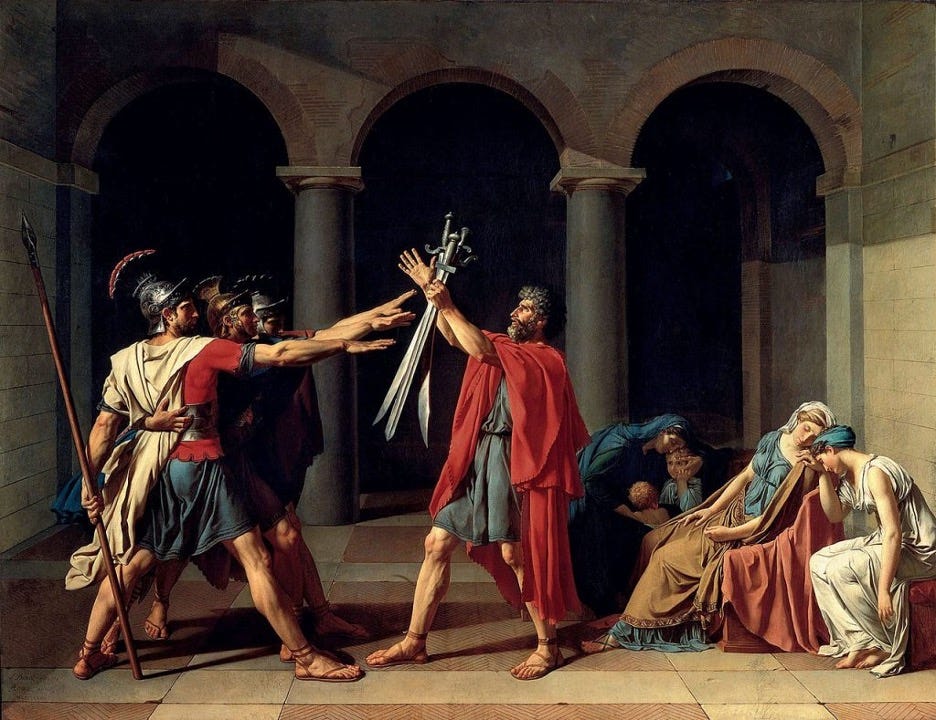
At this point, the issue of taking an oath in Ancient Rome is worth exploring. An oath was a ritual act. It expressed a particular intention towards others, often as a promise for the future. An oath (or sacramentum) of fidelity was taken upon marriage. It was also often required of religious and government leaders and soldiers.6 In the painting, The Oath of the Horatii (above), we see this rite taking place. According to Roman legend, the leaders of the warring cities of Rome and Alba decided to resolve their differences in a series of skirmishes by three representatives from each side, rather than through war. The three Horatius brothers (at left) swear on their swords held aloft by their father to win or die for Rome. In the dramatic painting, the men stand before a temple and vow to sacrifice themselves as the father summons a blessing from the gods.7 In returning to the Bocca della Verità, the notion of telling the truth in front of it (or at least in the precinct), might be a relic of such vows.8 The severity of the Bocca‘s countenance suggests its disposition to judge and eliminate liars.
If this is true, the issue of Joe and Peter’s frequent lies in their respective films is a curious one. We might question their true intentions toward Ann and Faith. Can the women trust them? This is difficult to know. Peter, in particular, seems most credible because of his earnest and repeated efforts in winning Faith’s heart; however, some people seem honest but are not. Since these films are romantic comedies, and not real life, we might be inclined to believe Joe and Peter’s sincerity, especially because the Mouth of Truth did not bite their hands off.
Copyright © 2026 by Rosi Prieto, Ph.D.
All Rights Reserved
A clip of this scene is found here:
Regarding the Bocca, see: https://en.wikipedia.org/wiki/Bocca_della_Verità and particularly Fabio Barry, “The Mouth of Truth and the Forum Boarium, Oceanus, Hercules, and Hadrian,” Art Bulletin (2011), pp. 7-37, (https://www.jstor.org/stable/23046567), see especially pp. 7-20.
Barry, pp. 7-20.
Barry, pp. 7-20.
https://metropolitandigital.com/the-conversation/6577-the-history-of-oath-ceremonies-and-why-they-matter-when-taking-office
Regarding David’s Oath of the Horatii, see: https://en.wikipedia.org/wiki/Oath_of_the_Horatii
Barry, p. 20.