

All About Eve
1950 Writer, Director: Joseph L. Mankiewicz
Starring: Bette Davis, Ann Baxter, Celeste Holm, George Sanders
SPOILER ALERT
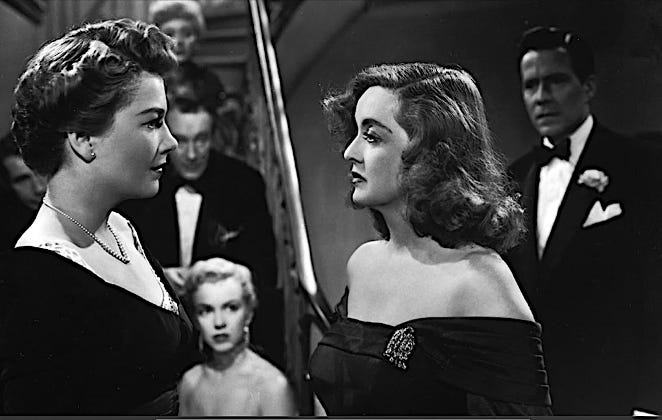
“All About Eve” (1950) is a great film about the gritty world of the theater, in which actors contend with fleeting fame, jealousy, and backstabbing. The story depicts a prominent middle-aged actress, Margo Channing (Davis), who is at the height of her career. A young, unassuming fan, Eve Harrington (Baxter), worms her way into Margo’s life and work to near disastrous ends. Written and directed by Joseph L. Mankiewicz, it is easily his crowning achievement. Among its many accolades, it was nominated for 14 Academy Awards and won six. It received two awards at the Cannes Film Festival and was nominated for six Golden Globes. In 1998, it was ranked number 16 on the American Film Institute’s list of the 100 Best American Films.
We might say that this great movie is about greatness. And, interestingly enough, it begins and ends with the theme of an award for greatness, a small statuette presented at a banquet by the “Sarah Siddons Society.” The film’s narrator (Sanders) informs us that it is “the highest honor our theater knows.” The fictitious award is presented to Eve Harrington (Baxter); she is lauded as a new actress with great potential. The ingenue is grateful for this honor. The playwright (Marlowe) and director (Gary Merrill) have already received their awards and can be seen at the table before them.
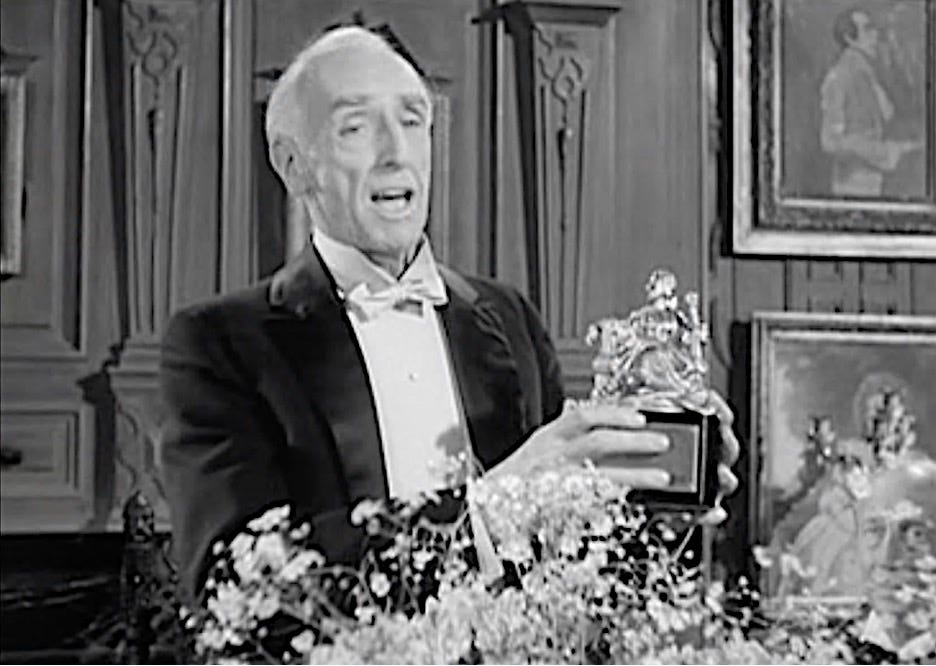
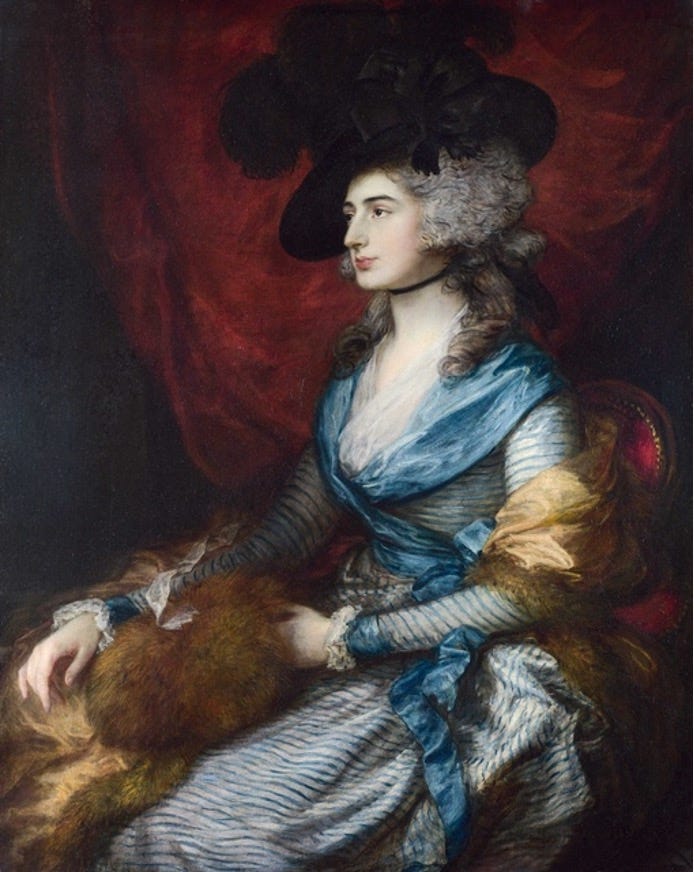
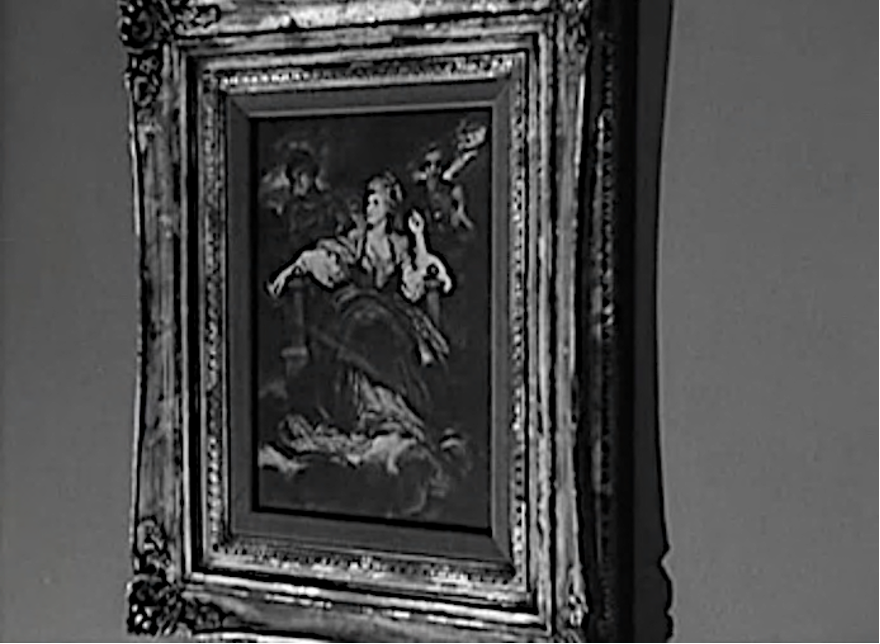
The small statuette in the film depicts Sarah Siddons (1755-1831) and is based on her portrait by Sir Joshua Reynolds (1723-1792) at the Huntington Library and Art Museum in Pasadena. The prize was perhaps inspired by the Tony Award (the Antoinette Perry Award for Excellence in Broadway Theater), which was founded in 1947. The choice of Siddons is an apt one for the trophy. She has been described as “the renowned tragic actress who dominated British theater during the late Georgian era and thrilled audiences throughout her fifty-year career with performances that seemed to surpass human ability.” And although at least 400 of her portraits survive—including the famous one by Thomas Gainsborough (1727-1788)—, the one by Reynolds is the most acclaimed, as it helped elevate the profession of acting in her time and also her own status to that of a cultural icon. The portrait, lauded as “most sublime,” at its exhibition in 1784 at the Royal Academy of Arts in London, where it stole the show, was titled by critics at the time as Mrs. Siddons in the Character of the Tragic Muse.1
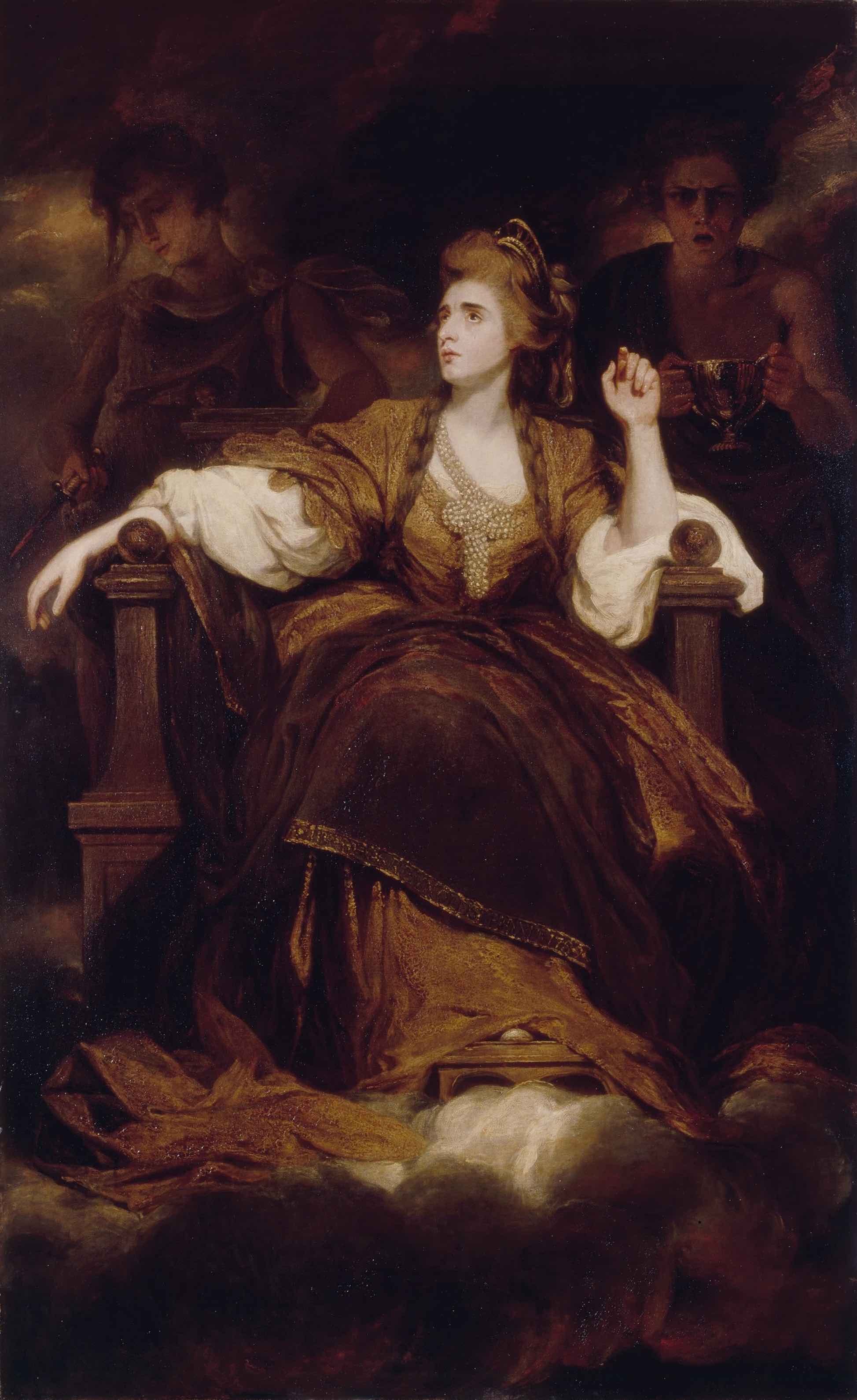
The notion of the Tragic Muse is appropriate in the film, and Mankiewicz aims the story toward a sophisticated audience who will be aware of at least some of its erudite references. In Greek mythology, Melpomene (the Tragic Muse) is the daughter of Zeus and sister of the other muses. Aristotle defined tragedy as a genre in which a noble hero (or heroine in the case of Margo) goes from good fortune to bad and his downfall is brought about not by vice or depravity, but by some error or frailty. The point of tragedy, then, is to focus on this character flaw to create an emotional response in the audience, which Aristotle termed “catharsis.”2 Since at least the time of Milton (1608-1674), tragedy was considered superior to comedy.3
Reynolds’s portrait presents Mrs. Siddons seated majestically on a throne floating upon clouds as she gazes sadly heavenward. She raises her left index finger and, with lips parted, seems about to deliver her anguished lines. Her face and hands are lit theatrically while all else is in darkness. In the film, a small, framed reproduction of the painting hangs in the stairwell of Margo’s home. And although many paintings can be seen hung on the walls in her home, it is the only one upon which the camera focuses—if only momentarily—to make an important point in the story.
The painting comes into view at a critical juncture of the film, during a party hosted by Margo. This is a watershed moment during which Margo says her famous line: “Fasten your seatbelts; it’s going to be a bumpy night!” And it is. Margo has now become fully aware of Eve’s betrayal and, significantly, her best friends brush off her attempts at convincing them of such. Indeed, they become Eve’s unwitting accomplices. And although played on a stairwell, this is also an important scene about the nature of the theater, as it becomes the main topic of discussion by the protagonists, including Eve. Here, a drunken Margo serves as theater critic when the arguing ensues and challenges the dramatist (Marlowe) when he suggests everyone go home instead of feuding: “And you pose as a playwright! A situation pregnant with possibilities and all you can think of is everybody go to sleep!” And as the guests depart, Eve targets his wife, Karen (Holm), to ensure success. Karen sweetly acknowledges that she will help her, unaware that she is being manipulated. As Karen descends the stairs, the camera momentarily focuses on the Siddons portrait, reminding us that tragedy will soon strike.
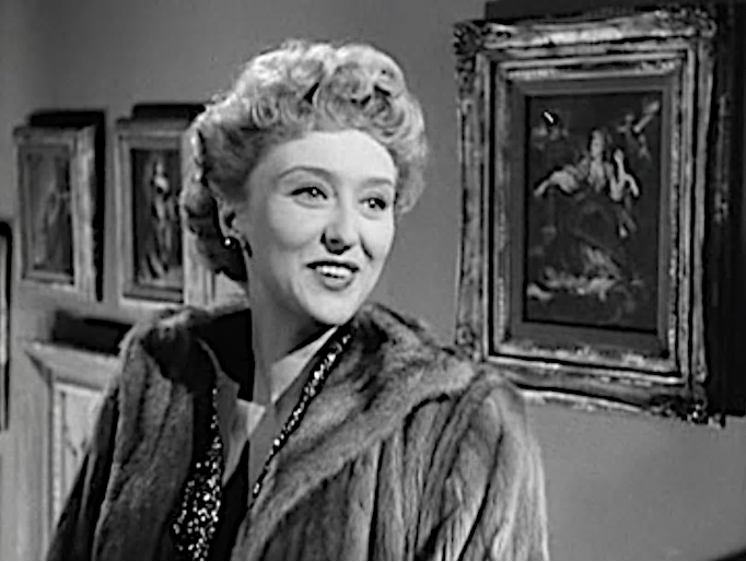
As noted earlier, Greek tragedy requires that the protagonist be a good person whose downfall is caused by a fatal flaw. Eve takes advantage of Margo’s vanity—she is a star accustomed to being adored. Eve pretends to idolize Margo, and Margo falls for it. Ancient Greek actors wore masks that personified types and we might say that Eve wears a mask that most of the others are unable to see through. Roger Ebert correctly observed that “The movie creates Margo Channing as a particular person, and Eve Harrington as a type.”4 Eve is a generalized idea of malevolence (Eve = evil), seeking the accolades and awards Margo has, without realizing the emptiness of such trifles.
So Eve receives the Sarah Siddons trophy in the movie. Two years after the film’s creation, the Sarah Siddons Society was established and the fictitious organization and award became a reality in Chicago. Coming full circle, Mankiewicz was awarded the trophy he conceived. His purported response to this honor was, “I invented it to put down all this fatuous prize-giving, and now there’s some outfit in Chicago actually promoting a Sarah Siddons Award every year.”5 Clearly, they were unaware of the irony of their actions.
Copyright © 2025 by Rosi Prieto, Ph.D.
All Rights Reserved
Robyn Asleson, ed., A Passion for Performance: Sarah Siddons and her Portraitists (1999).
See Tekla Bude, “What is Tragedy?” https://liberalarts.oregonstate.edu/wlf/what-tragedy.
See John Milton, “Preface to Samson Agonistes,” (1671): “Tragedy, as it was anciently composed, hath been ever held the gravest, moralest (sic), and profitable of all other poems; therefore said by Aristotle to be of power, by raising pity and fear, or terror, to purge the mind of those and such like passions. . . .” in E. Jones, ed., English Critical Essays: Sixteenth, Seventeenth and Eighteenth Centuries (1947).
See J. Mankiewicz, Joseph L. Mankiewicz: Interviews (2008), and “Bonhams : A Joseph L. Mankiewicz Sarah Siddons Award”.